Choosing an Attendance Method That Fits Your Business
Face, palm vein, fingerprint, NFC or GPS? Compare the five attendance methods used in Oman workplaces and see which one fits your offices, sites and field teams.
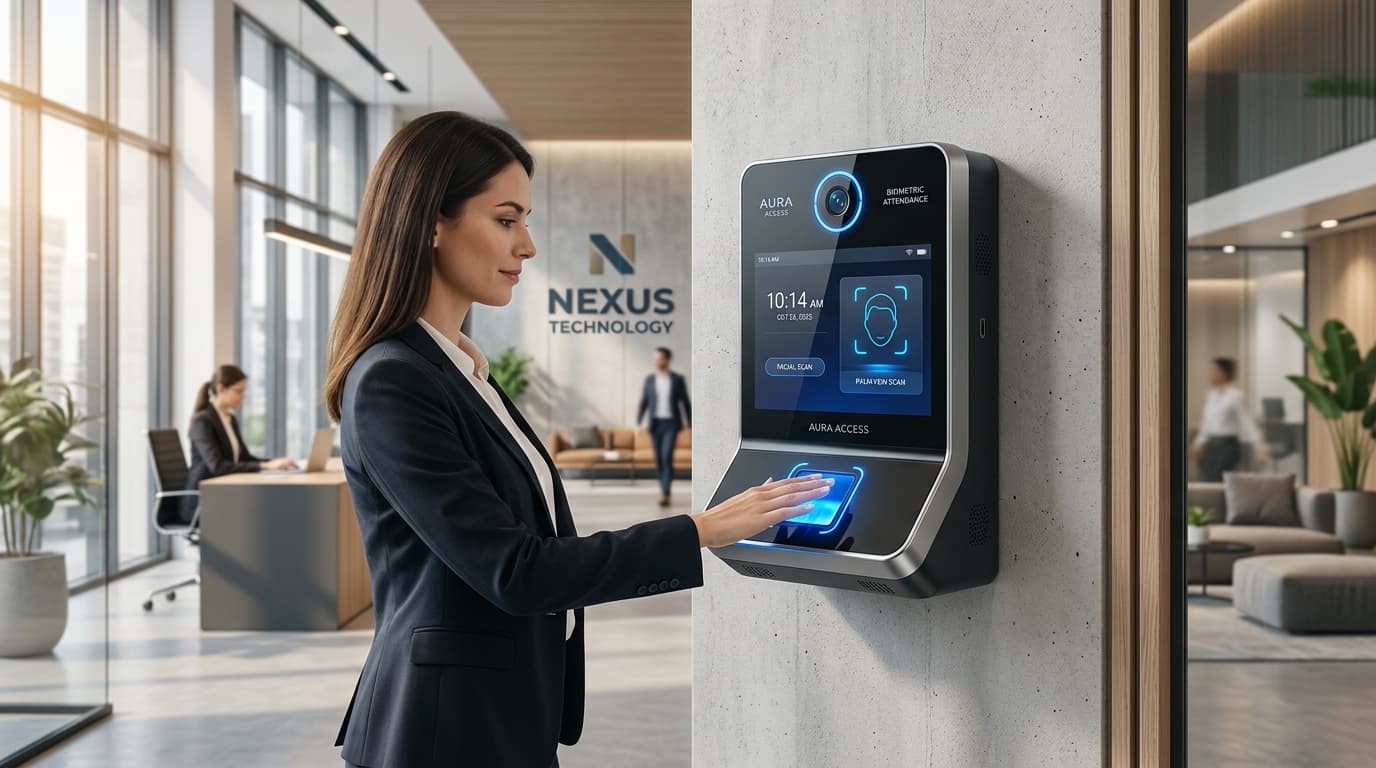
Most attendance problems in Oman are not really technology problems. They are mismatch problems. A business fits fingerprint readers at head office, then realises half the workforce is on a site in Sohar and never walks past the scanner. Or a company rolls out a mobile app to everyone, including the warehouse team who leave their phones in a locker.
Picking the right method is less about which technology is best and more about where your people actually are when they start work, and what their hands and working conditions are like when they get there.
There are five methods in common use. Here is how they compare.
Quick comparison
| Method | Best suited to | Main limitation |
|---|---|---|
| Facial recognition | Offices, reception areas, shift changes | Needs consistent lighting and sensible camera placement |
| Palm vein | Industrial sites, workshops, food handling, clinics | Higher hardware cost than fingerprint |
| Fingerprint | Offices, shops, clinics with one entrance | Struggles with worn, wet or dusty hands |
| NFC or card tap | High-volume gates and turnstiles | Not biometric, so a card can be handed over |
| GPS and mobile | Field staff, drivers, sales teams, remote sites | Depends on a charged phone with signal |
Facial recognition: fast and contactless, but placement matters
Staff walk up, the camera reads them, they are checked in. Nothing to touch, nothing to clean, and it clears a queue quickly at shift changes, which is why it tends to be the default choice for offices and reception areas.
The trade-off is environmental. Cameras need consistent lighting. A unit facing a glass entrance with hard afternoon sun behind it will produce more failed reads than the same unit mounted sensibly indoors. Get the placement right and it is close to effortless. Get it wrong and staff will tell you about it every morning.
Facial systems also deserve a slightly more careful conversation with your team than a fingerprint pad does. People feel differently about a camera, so how you introduce it matters.
Look for liveness detection, which distinguishes a real face from a photograph held up to the lens. Without it, facial recognition is easier to defeat than it looks.
Palm vein: the one most businesses have not considered
Palm vein readers scan the vein pattern beneath the skin of your hand using infrared. It is the method people know least about, and for a lot of businesses in Oman it is the one that actually solves their problem.
Because it reads beneath the surface, it is unaffected by the things that break fingerprint readers. Dust, cuts, calluses, dry skin, cement, oil, water. It is contactless, so hygiene concerns do not arise, which matters in food handling, healthcare and shared shift environments. And a vein pattern is internal, which makes it substantially harder to copy or spoof than a fingerprint left on a surface.
The trade-off is cost. Palm vein terminals are more expensive than fingerprint readers, so it is not the obvious choice for a small office where fingerprint would work perfectly well.
Palm vein suits you if you have industrial, workshop, kitchen or clinical environments where fingerprint reliability has been a recurring annoyance. If your supervisors regularly complain about failed reads, this is the fix.
Fingerprint: proven and cost-effective, within limits
Fingerprint readers are familiar, inexpensive and quick, and staff need no explanation. For an office, a clinic or a retail branch where everyone comes through one door, they do the job without fuss.
The weakness shows up in physical work. Fingers that have been handling cement, tools or cleaning chemicals do not read cleanly. Add dust and heat and a scanner that behaves perfectly in an air-conditioned reception becomes a queue-forming nuisance on a site. Some staff also prefer not to touch a shared sensor.
Fingerprint suits you if your team works indoors at fixed locations in roles that are not hard on the hands. Where those conditions do not hold, palm vein is usually the better spend.
NFC and card tap: fast, but be clear about what it is
An NFC badge or phone tap at the gate is the fastest option there is, which makes it genuinely useful at busy entrances and turnstiles where throughput is the priority.
One thing to be clear about, because it gets blurred in vendor material: NFC is not biometric. It verifies a card, not a person. A card can be lent to a colleague, which means it carries the same buddy punching exposure as a PIN or a signature sheet. If your reason for upgrading is that people are clocking in for each other, a card tap does not solve it.
Where NFC works well is high-volume access where the attendance risk is low, or as one factor alongside a biometric check on higher-security sites. Used on its own as your main attendance record, it leaves the gap open.
GPS and mobile: built for people who are never at the office
Fixed readers assume staff come to a building. Plenty do not. Construction supervisors move between sites. Sales teams start at a client. Delivery drivers, maintenance crews and field engineers may go a full week without seeing head office.
For these teams, mobile check-in with location capture is the only method that reflects reality. The employee checks in from their phone, and the system records where and when. It also gives you something a fixed reader cannot: proof of attendance at a specific site, which matters if you bill clients by presence or run several projects at once.
Look for geofencing, which only accepts a check-in inside an approved site perimeter, and selfie confirmation, which stops one person checking in the whole crew from a shared device. Offline capability matters too, since signal in remote areas and basements is not a given. Events should queue locally and sync when the connection returns.
Be straightforward with field teams about what is recorded. Capturing location at check-in and check-out is reasonable and easy to explain. Continuous tracking through the day is a different proposition and will cost you goodwill.
On accuracy figures
You will see match accuracy percentages quoted for all of these, usually in the high nineties. Those figures come from testing under controlled conditions, and they are a fair guide to how the methods rank against each other. Palm vein and facial systems generally test higher than fingerprint, which is consistent with how they work.
What they do not tell you is how a given unit will perform at your entrance, with your lighting, in your working conditions, with your staff. That is the number you actually care about, and no spec sheet can give it to you. Ask any vendor for a trial or a demonstration on site rather than deciding from a comparison chart.
Most businesses need more than one
This is rarely an either-or decision. A contracting company might have thirty office staff, well served by a facial terminal at reception, and eighty site workers across three governorates, who need something else entirely. A factory might want palm vein at the workshop entrance and NFC at the main vehicle gate.
Running separate disconnected systems for those groups is how you end up reconciling spreadsheets at month end. What you want is one attendance record covering everyone, whatever method each group uses to check in. That single record is also what feeds into payroll cleanly when it is time to prepare your WPS file.
This is how Markd is built. The terminals support face, palm vein, fingerprint and NFC on the same device, so you can deploy the right mode per site without buying different systems. Markd Field covers teams working away from a fixed location with GPS, geofenced check-in. Everything writes to one attendance record, and both sides work offline and sync when the connection returns.
Before you commit, check the compliance side
Face, palm vein and fingerprint data all count as biometric data under Oman's data protection law, which brings specific obligations around consent, secure storage and processing authorisation. GPS location data carries its own considerations. NFC card data does not fall in the same category, which is one genuine advantage of the card approach.
It is worth confirming that biometric attendance is legal in Oman on the terms you are planning before you buy hardware, since those obligations sit with you as the employer regardless of which vendor you choose.
When you compare options, a solid biometric attendance system in Oman should let you mix methods across sites, keep one clean attendance record, work offline, offer a fallback for staff who do not consent to biometrics, and export in the shape your payroll process needs.
Frequently asked questions
Which attendance method is best for field workers in Oman? Mobile check-in with GPS and geofencing. Fixed readers assume staff arrive at a building, which does not match how site, sales and delivery teams work.
What is palm vein attendance and how is it different from fingerprint? It reads the vein pattern beneath the skin using infrared, rather than the surface of the finger. That makes it contactless and unaffected by dust, cuts, moisture or worn hands, which is why it suits industrial and food handling environments.
Is NFC card attendance biometric? No. NFC verifies a card, not a person, so a card can be handed to a colleague. It is fast for high-volume entrances but does not prevent buddy punching on its own.
Can one system cover both office and field staff? Yes, and it is usually the better approach. Look for a platform supporting fixed terminals and mobile check-in that keeps one shared attendance record.
Do employees need to agree to biometric attendance? Yes. Biometric data requires consent under Oman's PDPL, so plan a non-biometric fallback for anyone who declines.
About CodeStack
CodeStack is a trusted software company in Oman delivering custom ERP systems, advanced GRC platforms, and scalable digital solutions for growing businesses. We help organizations streamline operations, improve compliance, and accelerate digital transformation through secure, business-focused software built for long-term success.
Start the Conversation
Ready to engineer your
next success?
Let's build something extraordinary together. Our team is ready to transform your vision into a scalable reality.