How Attendance Data Feeds WPS Payroll and Overtime Compliance
Payroll accuracy starts with attendance. Here is how hours, overtime and leave flow into your WPS salary file, and where manual tracking tends to break down.
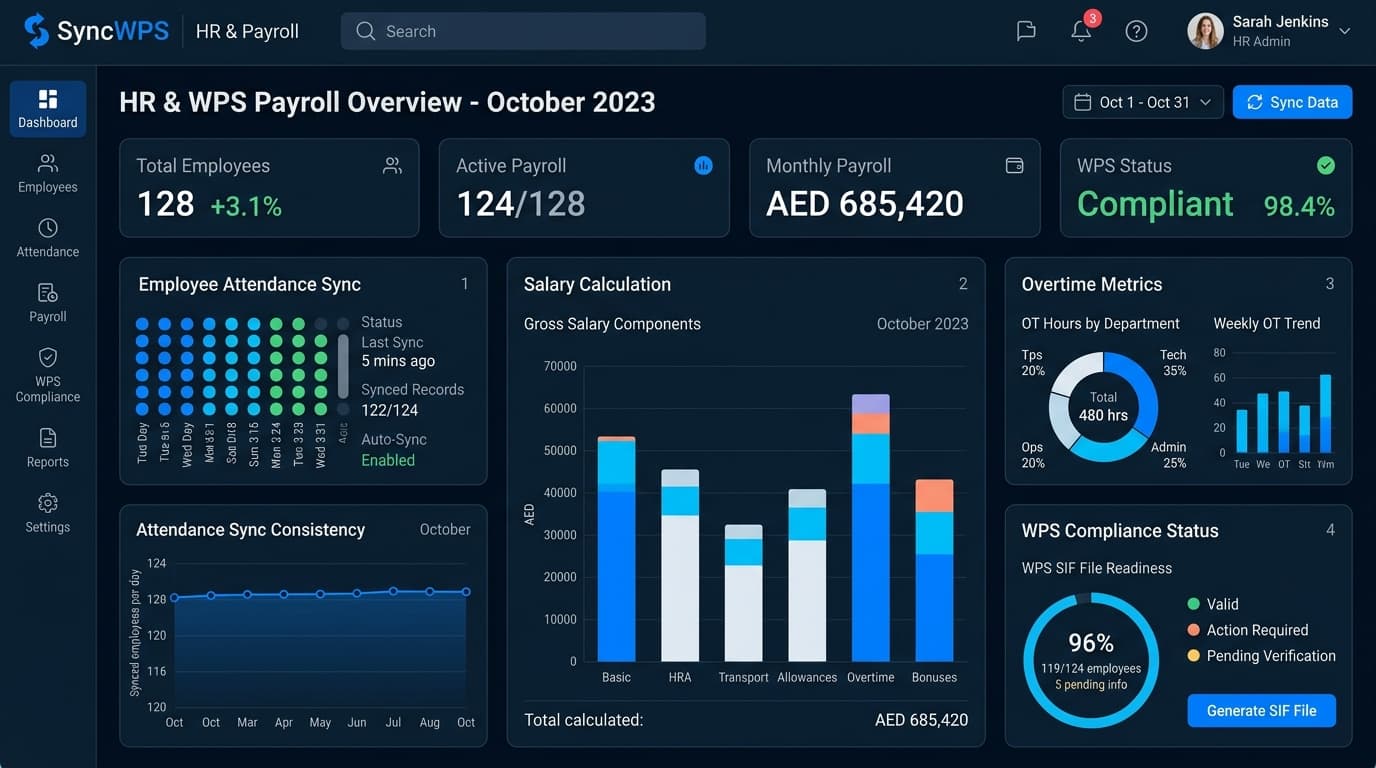
Most payroll problems do not start in payroll. They start weeks earlier, in how attendance was recorded.
A supervisor writes hours on a sheet. Someone types them into a spreadsheet. A few overtime claims arrive by WhatsApp. By the time the finance team is preparing the salary file, they are reconciling three versions of the same month, and the deadline is already close.
That deadline is a lot tighter than it used to be. Here is how the two ends of the process connect, and why the attendance side is where the real risk sits.
The three day window changes everything
Oman's Wage Protection System is the Ministry of Labour's electronic monitoring of private sector wage payments. Employers transfer wages into employee accounts at banks or financial institutions regulated by the Central Bank of Oman, matching what the employment contract says.
In December 2024, Ministerial Decision No. 729/2024 came into force, replacing the earlier Ministerial Decision No. 299/2023 and cutting the wage transfer deadline from seven days to three days from the end of the wage entitlement period. It also placed a contract accuracy obligation alongside that deadline, requiring employers to update employment contracts whenever a worker's wage changes.
Think about what three days actually means in practice. If your wage period ends on the last day of the month, payroll has to be finalised, checked and submitted by the third of the next month. There is no comfortable buffer left for chasing a missing timesheet, querying an overtime claim or fixing a data entry error, and bank processing still has to happen inside that window.
The Ministry also ran a phased rollout of coverage requirements through 2025, moving from at least 75 per cent of workers paid through the WPS to at least 90 per cent, concluding with full coverage. So this is no longer a large-employer concern. It applies broadly across the private sector.
The practical takeaway is simple. Your salary file has to be ready before the month closes, not assembled after it. And it can only be ready early if the attendance data behind it is already clean.
What actually flows from attendance into payroll
For most employers, a salary is not one fixed number. It is a base figure adjusted by what happened during the month. The adjustments almost all come from attendance records:
Days worked, including any unpaid absence
Overtime hours, which need to be authorised and correctly classified
Leave taken, split between paid annual leave, sick leave and unpaid days
Late arrivals or short days, where your policy applies a deduction
Weekly rest days and public holidays worked, which are treated differently from ordinary hours
Every one of those is a number that starts life at a door, a site or a phone, and ends up in your salary information file. If the starting number is wrong, everything downstream inherits the error, and you have transferred an incorrect wage that the Ministry can see.
The rules your hours records have to satisfy
Oman's Labour Law, issued under Royal Decree 53/2023, sets the framework your attendance data has to reflect. The core working time rules are eight hours a day and forty hours a week, with reduced hours of six a day and thirty a week for Muslim employees during Ramadan.
Those Ramadan hours are worth calling out, because they are a genuine annual trip hazard. For one month a year, the baseline against which overtime is calculated shifts for part of your workforce. A system that quietly carries on applying the standard eight hour day through Ramadan will misclassify hours, and the error compounds across every affected employee.
Overtime, work on weekly rest days and work on public holidays are all compensated differently from ordinary hours under the law. Getting these right depends less on knowing the law and more on whether your records can actually distinguish between the categories. A timesheet that shows a total of nine hours tells you nothing useful. A record that shows eight ordinary hours plus one authorised overtime hour on a normal working day is something you can pay from.
Employers are also expected to keep accurate working hours records and produce them if the Ministry inspects. That obligation exists whether or not you have a system in place, which is a reasonable argument for having one.
Where manual tracking usually breaks
The pattern is consistent across businesses that struggle here, and it is rarely carelessness. It is structural.
Data arrives too late. Paper sheets and spreadsheets tend to reach finance days after the period ends, which is exactly when the three day clock is already running.
Nobody can verify a disputed hour. When an employee says they worked a Friday and the record says otherwise, a handwritten sheet cannot settle it. Whoever argues more persistently usually wins, which is neither fair nor defensible.
Overtime is claimed, not measured. If overtime is self-reported and approved informally, you are paying based on memory rather than evidence. Some of it will be generous, some will be understated, and none of it is auditable.
Multi-site data never arrives together. A business with staff across Muscat, Sohar and Salalah usually ends up with three separate collection processes on three different rhythms.
Ramadan and holidays are handled by hand. The exceptions are precisely where errors cluster, and manual adjustment is where tired people make mistakes at month end.
Closing the gap
The fix is not complicated in principle. Attendance should be captured at the moment it happens, in a form that is already structured the way payroll needs it.
That means each check-in and check-out is recorded automatically, hours are classified as ordinary, overtime, rest day or holiday as they accrue, leave is deducted against entitlement in the same place, and the whole thing is exportable in the shape your salary file needs.
When that is running, month end stops being a reconciliation exercise. Finance opens a record that is already complete and reviews it, instead of rebuilding it from fragments. Suddenly three days is workable rather than alarming.
It also gives you something valuable if a payment is ever questioned: a timestamped record of who worked when, sitting behind every figure in your salary file.
A biometric attendance system in Oman is the usual foundation for this, because biometric or verified mobile check-in removes the ambiguity that manual sheets create. If you are weighing up which method suits your workforce, it is worth comparing fingerprint, facial and GPS check-in before committing, and confirming the consent and PDPL rules that apply to biometric data.
Markd was built around this connection. Markd Identity covers in-office check-in and Markd Field covers teams working away from a fixed site, both feeding one attendance record that carries the classifications payroll needs, so the handover between attendance and payroll stops being a manual step.
Frequently asked questions
What is the WPS deadline for paying salaries in Oman? Employers must transfer wages through the WPS within three days from the end of the wage entitlement period, following Ministerial Decision No. 729/2024.
Does attendance data need to match payroll records? Yes. Your salary file should reflect actual hours worked, overtime and leave taken. If attendance records and payroll disagree, you have no defensible basis for the amount paid.
How are Ramadan working hours handled in payroll? Working hours reduce to six a day and thirty a week for Muslim employees during Ramadan. Your system needs to apply that reduced baseline, otherwise overtime for that month will be calculated incorrectly.
Do small businesses have to use the WPS? The Ministry ran phased coverage requirements through 2025 that concluded with full coverage across the private sector, so employers should assume it applies and confirm their position with the Ministry.
About CodeStack
CodeStack is a trusted software company in Oman delivering custom ERP systems, advanced GRC platforms, and modern HR software in Oman for growing businesses. We help organizations streamline operations, improve compliance, and accelerate digital transformation through secure, business-focused software built for long-term success.
Start the Conversation
Ready to engineer your
next success?
Let's build something extraordinary together. Our team is ready to transform your vision into a scalable reality.