Is Biometric Attendance Legal in Oman? What Employers Need to Know
Biometric attendance is legal in Oman if you handle it right. Here is what the PDPL requires on consent, permits and data protection before you roll it out.
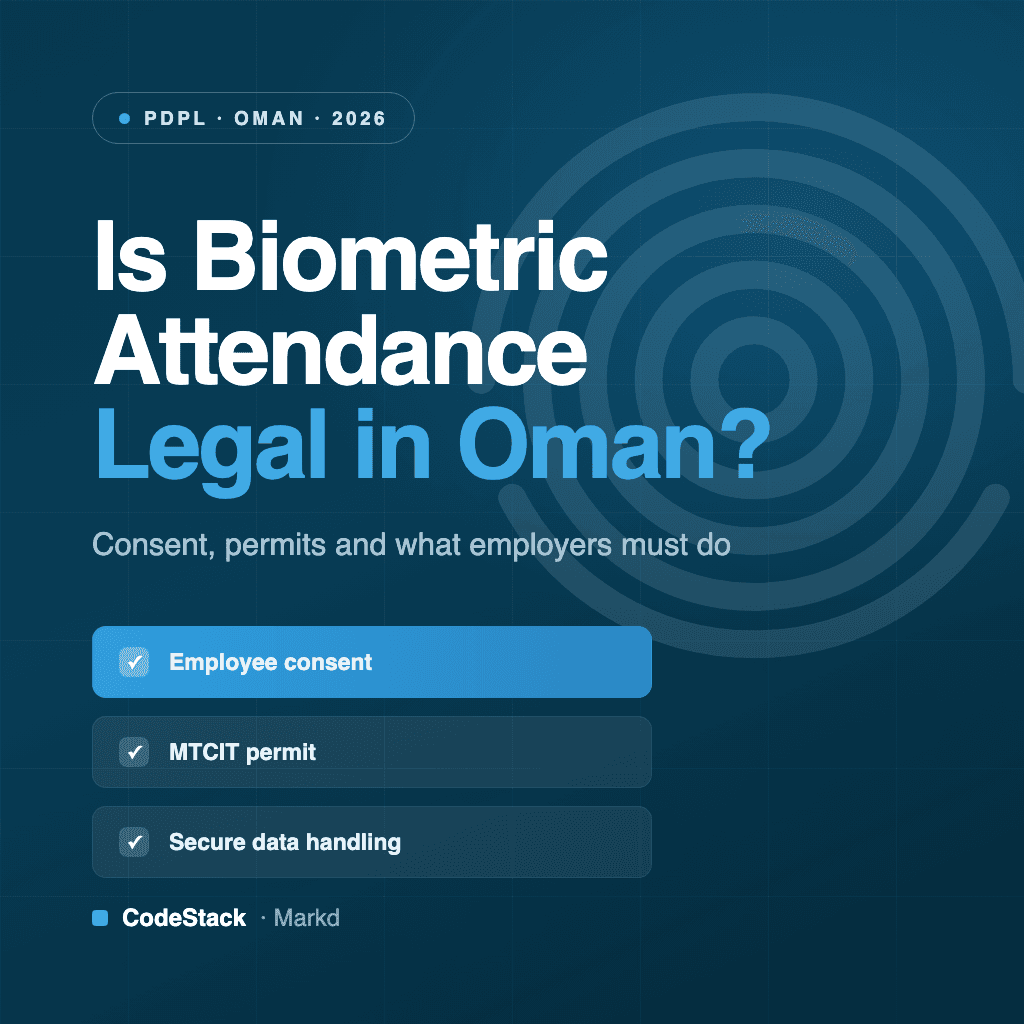
Fingerprint scanners and face recognition have quietly become the normal way to track attendance in Oman. Before you fit one at your entrance, it is worth asking a simple question that a lot of businesses skip: are you actually allowed to collect that data? The short version is yes, but only if you do it properly.
Here is what the law expects, in plain terms.
The short answer
Biometric attendance is legal in Oman. There is no rule that bans fingerprint or facial recognition for tracking staff hours. What the law does say is that a fingerprint or a face scan is not ordinary information. It sits in a protected category, and that comes with conditions. You need clear consent from your employees, you need the right authorisation to process this kind of data, and you need to keep it secure. Miss those steps and a perfectly ordinary attendance system turns into a compliance problem.
How Oman's data protection law treats biometric data
Oman's Personal Data Protection Law, usually shortened to the PDPL, was issued under Royal Decree 6/2022, with detailed executive regulations following under Ministerial Decision 34/2024. The grace period for businesses to fall in line ended in early 2025, so the law is now fully in effect. The regulator is the Ministry of Transport, Communications and Information Technology, or MTCIT.
Most employee information, like a name or a phone number, is treated as standard personal data. Biometric data is different. The PDPL puts it in a special, more sensitive category alongside things like health and genetic data. The reason is obvious once you think about it. You can reissue a password or change a bank card. You cannot change your fingerprint. So the law asks for a higher bar before a business can collect and use it.
In practice that higher bar means two things you cannot skip: proper consent, and permission to process sensitive data.
What counts as valid employee consent
Consent is the heart of the PDPL. The law is built on an opt-in principle, which means you cannot process someone's personal data unless they have agreed to it or another lawful basis applies.
For biometric attendance, consent has to be more than a line buried in a contract. Under the regulations, consent needs to be:
Freely given, so an employee does not feel pushed into it
Informed, so they know exactly what is being collected and why
Specific, so it covers attendance and not some vague future use
Recorded, in writing or by clear electronic means
Employees also keep the right to withdraw consent later, and they can ask to see, correct or delete their data. As a business you have to respond to those requests within 45 days. This is where a lot of employers trip up. They install the hardware, switch it on, and never actually collect a clean, documented yes from their team. Do that part first.
A fair question comes up here: can an employee simply refuse? In principle they can, so it is sensible to keep a backup method available, such as a PIN or a card, for anyone who does not consent. Building that flexibility in from the start saves you an awkward conversation later.
The permit you need for sensitive data
This is the step most guides leave out. Because biometric data is a sensitive category, processing it is not something you can just decide to do on your own. The MTCIT lists biometric data among the categories that require a permit from the Ministry before processing, alongside genetic data, health data and a small number of other sensitive types. A permit, once granted, can run for up to five years, and it can be pulled if you break the rules.
What this means for you as an employer is that biometric attendance is not only an IT decision, it is a data protection decision. Before rollout, check whether your processing needs an MTCIT permit for your situation and get that in order. If you are unsure, this is the point to bring in legal counsel rather than guess. The cost of getting it wrong, including fines and the reputational hit, is far higher than the cost of a quick review.
A quick compliance checklist for employers
If you are putting in biometric attendance, or you already have it running, walk through this:
Collect clear, written consent from each employee before you capture any biometric data
Tell staff what you collect, why, how long you keep it, and who can see it
Offer an alternative check-in method for anyone who does not consent
Confirm whether you need an MTCIT permit for processing sensitive data, and sort it before go-live
Store biometric data securely, with access limited to the people who genuinely need it
Be ready to handle access, correction and deletion requests within 45 days
Appoint a data protection officer, which the PDPL expects, and know your 72 hour breach reporting duty
None of this is meant to scare you off. Plenty of businesses in Oman use biometric attendance without any issue. The point is to treat the data with the care the law expects.
What to look for in your attendance system
Compliance is not only about paperwork. The system you pick either does a lot of the heavy lifting for you, or it makes life harder. A good biometric attendance system in Oman should make consent, security and access control easy rather than something you bolt on afterwards.
A few things worth checking before you buy:
How and where biometric data is stored, and whether it is encrypted
Whether you can set who has access to attendance records
Whether it supports a non-biometric fallback for staff who opt out
Whether you can export or delete an individual's data when you need to
It is also worth thinking about choosing the right attendance method for your workforce before you commit to hardware, since fingerprint, facial and mobile check-in suit quite different working patterns.
This is the thinking behind Markd, our workforce platform built for Oman businesses. It covers in-office biometric check-in and mobile options for field teams, with the data handling side treated as a first-class concern rather than an afterthought.
Frequently asked questions
Do I need written consent for fingerprint attendance in Oman?
Yes. Biometric data is a sensitive category under the PDPL, so you need clear, informed, written or electronically recorded consent from each employee before you collect it.
Can an employee refuse biometric attendance?
They can. Consent has to be freely given, so it is wise to offer an alternative such as a PIN or card for anyone who does not agree to biometric check-in.
Is facial recognition attendance allowed in Oman?
Yes, on the same terms as fingerprint. Both are biometric data, so both need consent, secure handling, and the right authorisation to process sensitive data.
Where should biometric data be stored?
Securely, with encryption and limited access. You should also be able to retrieve or delete an individual's data to meet PDPL requests within the 45 day window.
A quick note: this is general guidance to help you plan, not legal advice. For your specific setup, confirm the permit position with the MTCIT or your legal adviser before you roll out.
About CodeStack
CodeStack is a trusted software company in Oman delivering custom ERP systems, advanced GRC platforms, and scalable digital solutions for growing businesses. We help organizations streamline operations, improve compliance, and accelerate digital transformation through secure, business-focused software built for long-term success.
Start the Conversation
Ready to engineer your
next success?
Let's build something extraordinary together. Our team is ready to transform your vision into a scalable reality.