In-House vs Outsourced Software Partner in Oman: How to Decide
A practical guide to choosing between an in-house dev team and a software partner in Oman. Costs, Omanisation, hybrid models, and what really wins.
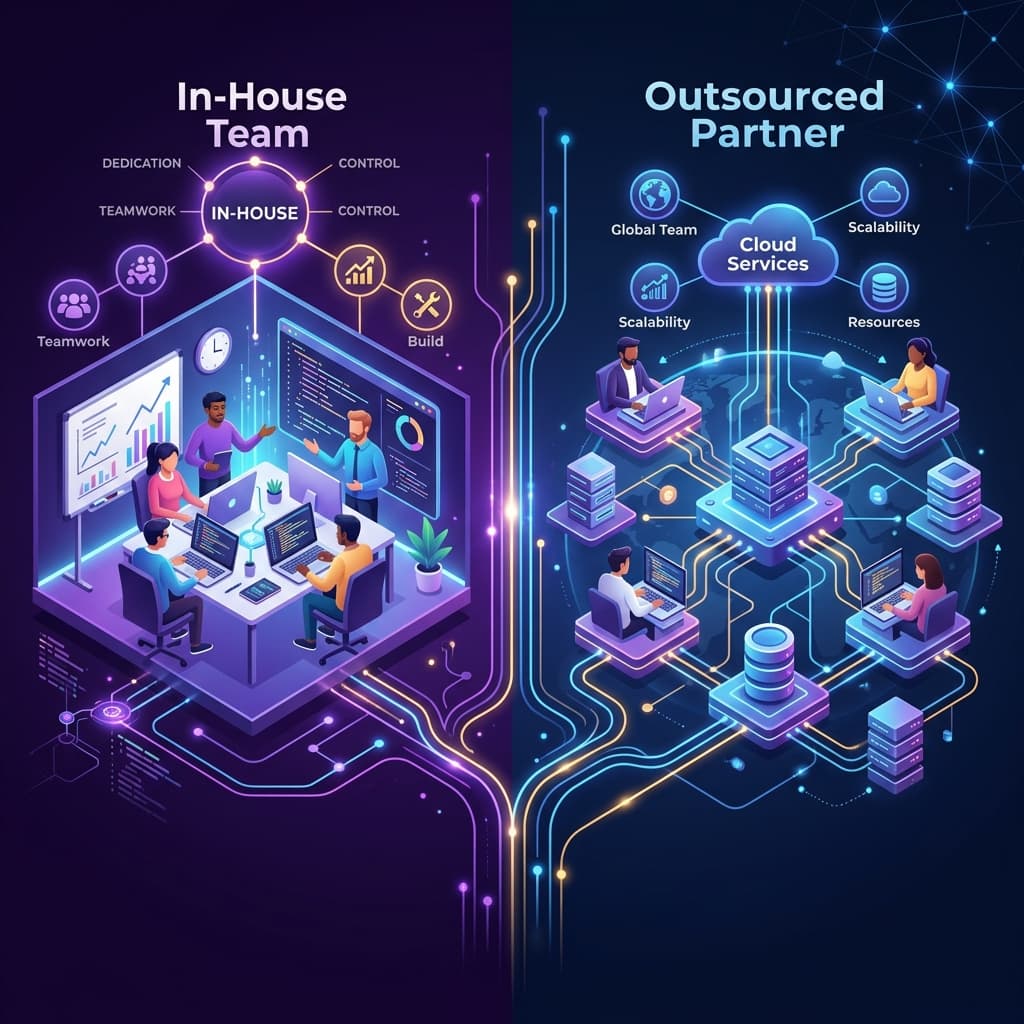
Most Omani businesses asking this question are framing it wrong.
The better question is: what mix of internal capability and external partnership gets us where we need to go, at a cost we can sustain? If you're at the broader partner-selection stage, our framework for choosing a software company in Oman covers vetting in detail.
The four real options
1. Fully outsourced. All software development is delivered by an external partner. Internal team is zero or one person who manages the relationship.
2. Outsourced with one strong internal owner. External partner does the building, but one experienced internal hire owns outcomes, manages the partner, and protects institutional knowledge. The most common setup for serious Omani SMEs.
3. Hybrid model. A small internal team handles ongoing development and small features. An external partner handles bigger initiatives and capacity surges.
4. Fully in-house. An internal team of five plus engineers handles everything. Rare outside the tech industry, banks, telecoms, and very large groups.
When in-house genuinely makes sense
Building an internal team is the right call when all of the following are true:
Software is core to your competitive advantage, not just a supporting function
You have at least one significant product that needs continuous development for years
Your annual development workload would justify three or more full-time engineers
You can attract and retain real talent in Oman's tight tech labour market
Fewer than 10 percent of non-tech Omani businesses actually need a full internal dev team.
When outsourcing wins
Software supports the business but isn't the core product
Development needs are project-based or seasonal rather than continuous
You don't have the management capacity to run a technical team
Time to market matters and a partner can ramp faster than internal hiring
Why the hybrid model wins for most serious businesses
One strong internal owner plus a long-term external partner consistently outperforms both extremes:
The internal owner protects institutional knowledge and prevents partner lock-in
The external partner provides depth across multiple skill sets without full-time cost
You scale capacity up and down as project demand changes
You maintain control of source code, data, and product direction
The Omanisation factor
The policy. Omanisation requires private sector employers to maintain a minimum percentage of Omani nationals in their workforce, with sector-specific quotas set by the Ministry of Labour under Royal Decree 53/2023. For the IT sector, the Ministry of Transport, Communications and Information Technology has signalled a targeted Omanisation rate around 63 percent across the sector.
Recent tightening. Under Ministerial Decision No 602/2025, companies meeting Omanisation targets receive a 30 percent reduction in visa and licensing fees. Those missing targets face fees at twice the standard rate. Penalties can include fines of OMR 500 to OMR 1,000 per missing Omani employee.
What this means for in-house teams. If you build a dev team of six engineers, you need to factor Omanisation into the hiring plan from day one. Recruitment cycles for senior Omani tech talent are longer, and training programmes for junior Omani engineers add overhead.
The cost picture
In-house dev team of three:
Annual salary cost: OMR 60,000 to 90,000
Benefits, allowances, end-of-service: add 25 to 35 percent
Recruitment, training, equipment: OMR 5,000 to 10,000 first year
Total year-one cost: OMR 80,000 to 130,000
One internal head of digital plus a long-term partner:
Internal salary plus overhead: OMR 25,000 to 45,000
Partner retainer or project engagement: OMR 30,000 to 80,000
Total annual cost: OMR 55,000 to 125,000
Fully outsourced:
Project-based or retainer: OMR 25,000 to 80,000 annually
A practical decision framework
Is software your core product, or a supporting capability? Core = in-house or hybrid.
Do you have continuous or project-based development needs? Continuous = in-house or hybrid.
Could you justify three or more full-time engineers? No = outsource.
Do you have a senior leader who can manage technical teams? No = outsource is safer.
How urgent is time to market? Urgent = outsource ramps faster.
Are you building one product or running many software initiatives? Many = hybrid fits best.
The hidden factor: maturity of your own systems
Do an honest audit of your current digital state. Our digital transformation roadmap for Oman walks through how to do this properly. If your systems aren't ready for sustained development, fix that first.
A messy ERP environment swallows in-house engineering capacity faster than expected. Our ERP implementation guide for Oman covers what good looks like.
Common mistakes on this decision
Hiring in-house to 'save money.' Almost never works for non-software-first businesses.
Outsourcing without an internal owner. A partner without a strong counterpart on your side ends up making decisions that should be yours.
Underestimating Omanisation in in-house planning. Building a mostly expat team is no longer realistic without a clear plan from day one.
Treating the decision as permanent. Many Omani businesses move from fully outsourced to hybrid as they grow.
FAQs
Can a small Omani business start with one part-time technical hire and a partner?
Yes. A part-time CTO or technical advisor, plus a long-term software partner, is a strong starting setup.
Are offshore-only outsourced teams a good option?
Cheaper on paper, often more expensive in practice. Communication gaps and the absence of on-the-ground support usually erase the saving.
What to do next
The team at CodeStack works with Omani businesses across the spectrum: fully outsourced for SMEs, as the external arm of hybrid setups for mid-market businesses, and as a specialist resource for larger groups with their own internal teams. We're happy to start with a conversation about what setup actually fits your business.
About CodeStack
CodeStack is a trusted software company in Oman delivering custom ERP systems, advanced GRC platforms, and scalable digital solutions for growing businesses. We help organizations streamline operations, improve compliance, and accelerate digital transformation through secure, business-focused software built for long-term success.
Start the Conversation
Ready to engineer your
next success?
Let's build something extraordinary together. Our team is ready to transform your vision into a scalable reality.