Native vs Hybrid Apps in Oman: How to Choose the Right Approach
A practical guide to choosing native or hybrid mobile apps for Omani businesses. Cost, performance, bilingual support, and which approach wins.
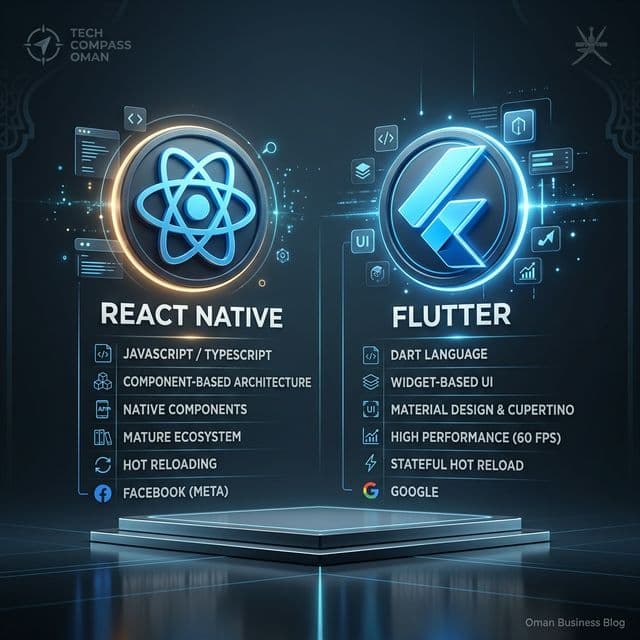
The 'native or hybrid' question is the wrong question for most Omani businesses.
This guide walks through the real options, what each costs, and how to pick the right approach. If you're still working out a budget, our mobile app development cost guide for Oman covers the wider pricing reality first.
The four real options
1. Native iOS and native Android. Two separate apps in Swift and Kotlin. Maximum performance. Highest cost, longest timeline, most maintenance.
2. Cross-platform with React Native. One codebase targeting both iOS and Android. Built using JavaScript and React. Backed by Meta, mature ecosystem, large pool of developers.
3. Cross-platform with Flutter. One codebase targeting iOS, Android, web, and desktop. Built using Dart. Backed by Google. Strong for apps where polished, consistent UI matters.
4. Progressive Web App (PWA). Built once as a web application. No app store, no install required. Lowest cost, fastest time to market. Limited device feature access.
When native is genuinely the right call
Native makes sense when:
The app does heavy graphics or 3D rendering
Performance demands are extreme, like real-time video processing or live streaming
The app integrates deeply with platform-specific hardware
Battery and memory efficiency are make-or-break requirements
For most business apps in Oman, the performance gap between native and modern cross-platform is small enough that the cost gap doesn't justify it.
When cross-platform is the right call (most of the time)
Cross-platform wins when:
Budget is meaningful and you need the same money to cover iOS and Android
Time to market matters and you can't wait for two parallel native builds
The app is feature-driven, not graphics-driven
You want to launch on both platforms simultaneously
For most Omani SMEs, cross-platform delivers 90 percent of the user experience for 50 to 70 percent of the cost.
React Native or Flutter: the practical difference
For B2B and operational apps, both work equally well. Pick based on which framework your development partner is stronger in.
For consumer apps where visual polish drives conversion, Flutter often produces a more uniformly polished result faster.
For apps sharing code with an existing React-based web app, React Native saves significant time.
The framework choice matters less than the team building it.
The Omani context that affects this decision
1. Android dominance. Oman is overwhelmingly an Android market. According to StatCounter's mobile OS data for Oman, Android holds the majority of mobile traffic. Cross-platform skips the platform sequencing problem by launching on both stores at once.
2. Bilingual requirements. Most Omani apps need Arabic and English from day one. With two native codebases, you're testing every Arabic UI flow twice. With cross-platform, you test once.
3. Network reality. Omani users span fast 5G in Muscat to spotty connections in interior regions. Apps need to handle offline state and slow networks gracefully.
Cost comparison
Native iOS only: OMR 4,000 to 9,000, 4 to 6 months
Native Android only: OMR 4,000 to 9,000, 4 to 6 months
Native both platforms: OMR 8,000 to 18,000, 5 to 8 months
React Native (both platforms): OMR 5,000 to 12,000, 4 to 6 months
Flutter (both platforms): OMR 5,000 to 12,000, 4 to 6 months
Progressive Web App: OMR 2,500 to 7,000, 2 to 4 months
Cross-platform typically saves 30 to 45 percent on initial build versus two native apps, and 20 to 30 percent on annual maintenance.
Sector patterns in Oman
Retail and e-commerce: Cross-platform almost always.
Logistics and fleet: Cross-platform with offline-first design.
B2B and internal tools: Cross-platform. Time-to-feature matters more than raw performance.
Games and AR experiences: Native, or specialised game engines like Unity.
For a wider view of how this fits into your software strategy, our complete software development guide for Oman covers the bigger picture. At the partner-selection stage, our framework for choosing a software company in Oman covers what to look for.
FAQs
Will my users notice the difference between native and cross-platform?
In a typical business app, no. Users notice quality of design and reliability of functionality far more than the underlying framework.
Which is more future-proof, React Native or Flutter?
Both are mature, well-supported, and used at scale globally. Either is a safe long-term bet in 2026.
What to do next
The app development team at CodeStack builds with both React Native and Flutter, and recommends native only when the workload genuinely requires it. We'd rather scope an app honestly than win a project that's the wrong fit.
About CodeStack
CodeStack is a trusted software company in Oman delivering custom ERP systems, advanced GRC platforms, and scalable digital solutions for growing businesses. We help organizations streamline operations, improve compliance, and accelerate digital transformation through secure, business-focused software built for long-term success.
Start the Conversation
Ready to engineer your
next success?
Let's build something extraordinary together. Our team is ready to transform your vision into a scalable reality.