Digital Transformation in Oman: A Vision 2040 Aligned Roadmap for Businesses
A practical digital transformation roadmap for Omani businesses aligned with Vision 2040. Phases, priorities, sector patterns, and how to start.
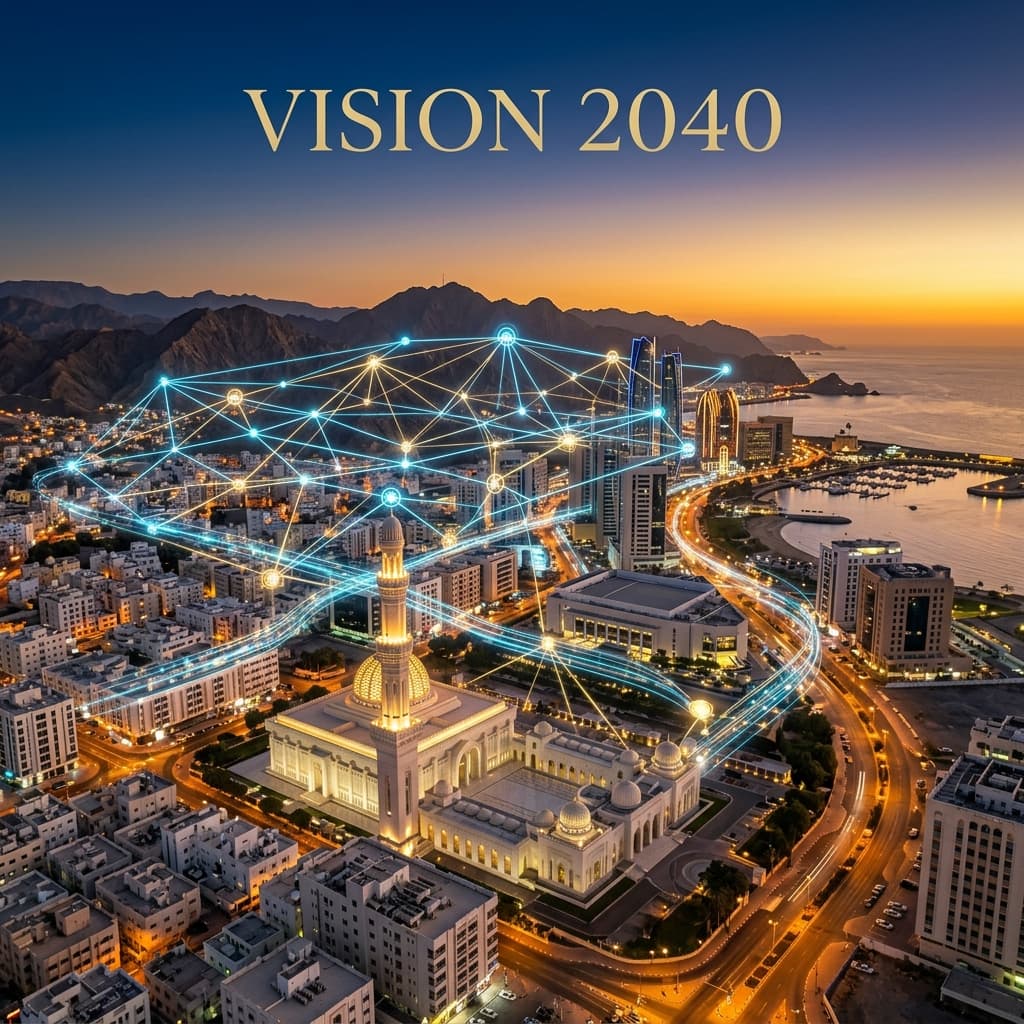
Most Omani businesses don't have a digital transformation problem. They have a digital transformation framing problem.
This guide is a practical roadmap. Aligned with Oman Vision 2040, but written for the people who'll have to make it happen on the ground. If you're earlier in the journey and want the wider picture of how software fits in, our complete software development guide for Oman covers the market and pricing reality first.
Why this matters now, not later
First, the national direction is set. Oman Vision 2040 is the national reference for economic and social planning, and digitalisation is one of its core pillars. The government has set a target to grow the digital economy's contribution to GDP from around 2 percent today to 10 percent by 2040. This is reflected in the National Program for the Digital Economy, structured around accelerating digital government, enhancing the digital society, and enabling business digitalisation.
Second, the regulatory floor is rising. VAT compliance, Fawtara e-invoicing rolling out from August 2026, and increasing data residency expectations all assume your business runs on systems that produce structured digital outputs.
Third, your customers have moved. According to IMF research on digitalisation in Oman, Oman has among the highest internet penetration and 4G/5G coverage in the region. Your customers transact, research, and decide on a phone.
What digital transformation actually means
Digitisation. Turning analogue records and processes into digital ones.
Digitalisation. Using digital tools to improve how existing processes work.
Digital optimisation. Using digital data to make better decisions.
Digital transformation. The whole business model or operating model changes because digital makes something newly possible.
Most Omani SMEs don't need full transformation. They need solid digitisation, real digitalisation, and a few targeted optimisation projects.
The five layers of business digitalisation
Core operations. ERP, accounting, inventory, HR, procurement. If this is fragmented across spreadsheets and disconnected tools, nothing else works well. Our ERP implementation guide for Oman walks through what this layer looks like done properly.
Customer experience. Website, mobile app, e-commerce, customer support tools. Our web development services and app development team handle the build side of this layer.
Sales and marketing. CRM, lead capture, marketing automation, analytics. Often the cheapest layer to upgrade and the one with the fastest payback for SMEs.
Data and reporting. The layer that turns operational data into decisions.
Specialised technology. AI, automation, IoT, advanced analytics. Useful when the foundations are solid. Wasteful when they're not.
A four-phase roadmap framework
Phase 1: Foundations (months 0 to 6)
Audit current systems, processes, and data
Fix accounting, inventory, and payroll if on spreadsheets or aging software
Bring VAT compliance and Fawtara e-invoicing readiness into scope. Our VAT and e-invoicing ERP requirements guide for Oman covers this in detail.
Phase 2: Core systems (months 6 to 18)
Roll out an ERP appropriate to your scale. Our custom ERP versus off-the-shelf guide covers the decision.
Modernise the customer-facing layer. Website rebuild, app where justified, e-commerce if you sell products.
Set up a CRM and basic marketing automation.
Phase 3: Data and integration (months 18 to 30)
Integrate the systems built in Phase 2 so data flows once.
Build basic dashboards covering the four or five metrics that actually move the business.
Phase 4: Optimisation and advanced capability (month 30 onward)
Targeted automation of the highest-volume manual processes.
Selective AI applications where the data is clean enough to support them.
New revenue streams or business models the digital foundation now makes possible.
The economics: what this actually costs
Phase 1 (foundations): OMR 3,000 to 15,000
Phase 2 (core systems): OMR 12,000 to 60,000
Phase 3 (data and integration): OMR 8,000 to 30,000
Phase 4 (optimisation): OMR 10,000 to 50,000+
According to World Bank analysis aligned with Vision 2040, non-oil sectors are growing quickly under the broader reform agenda, and businesses participating actively in the digital economy are well placed to capture that growth.
The mistakes that wreck digital transformation projects
Buying technology before fixing process. A bad process automated is a bad process at scale.
Treating it as an IT project. This is a business change project that includes IT.
Skipping change management. Software you don't train people on is software you've thrown away.
Doing too many things at once. Three concurrent major projects almost always means three delayed projects.
Picking the wrong partner. Our framework for choosing a software company in Oman covers vetting in detail.
FAQs
Do small businesses really need a digital transformation roadmap?
Yes, scaled to size. A ten-person service firm still needs basic systems, a customer-facing presence, and clean data.
What's the most common starting point for digital transformation in Oman?
ERP modernisation or accounting migration. Most Omani SMEs are still running aging desktop accounting or partial spreadsheets.
Where to start the conversation
The team at CodeStack builds and supports digital transformation programmes for Omani businesses across retail, manufacturing, hospitality, services, and healthcare. Reach out when you're ready to map your roadmap.
About CodeStack
CodeStack is a trusted software company in Oman delivering custom ERP systems, advanced GRC platforms, and scalable digital solutions for growing businesses. We help organizations streamline operations, improve compliance, and accelerate digital transformation through secure, business-focused software built for long-term success.
Start the Conversation
Ready to engineer your
next success?
Let's build something extraordinary together. Our team is ready to transform your vision into a scalable reality.