Oman's New Fawtara Deadlines: What Decision 189/2026 Means for Your Business
Oman moved its e-invoicing dates. See when Fawtara applies to your business, what changed under Decision 189/2026, and how to prepare in time.

If you planned your e-invoicing project around the old Fawtara timeline, it's time to look at your calendar again.
In August 2026, the Oman Tax Authority issued Decision No. 189/2026. It turned Fawtara from a programme into a legal duty, and it replaced the old four-phase rollout with two simple dates. Some businesses now have more time than they expected. Others have less than five months.
This guide covers the new Oman e-invoicing deadline, how to work out which date applies to you, and what to do between now and then. It's written in plain language for the people who will actually run the project, from finance managers to business owners.
What Changed Under Decision 189/2026
Until August 2026, Fawtara was guided mostly by OTA announcements and an FAQ. The plan had four phases: a pilot with 100 large companies in August 2026, then all large companies, then everyone else, with government entities around 2028.
Decision 189/2026 changes that in three important ways.
E-invoicing is now law. The decision amends the Executive Regulations of the VAT Law. It was published in the Official Gazette on 9 August 2026, as reported by the Oman Observer. Format and security rules that used to be guidance now have legal force.
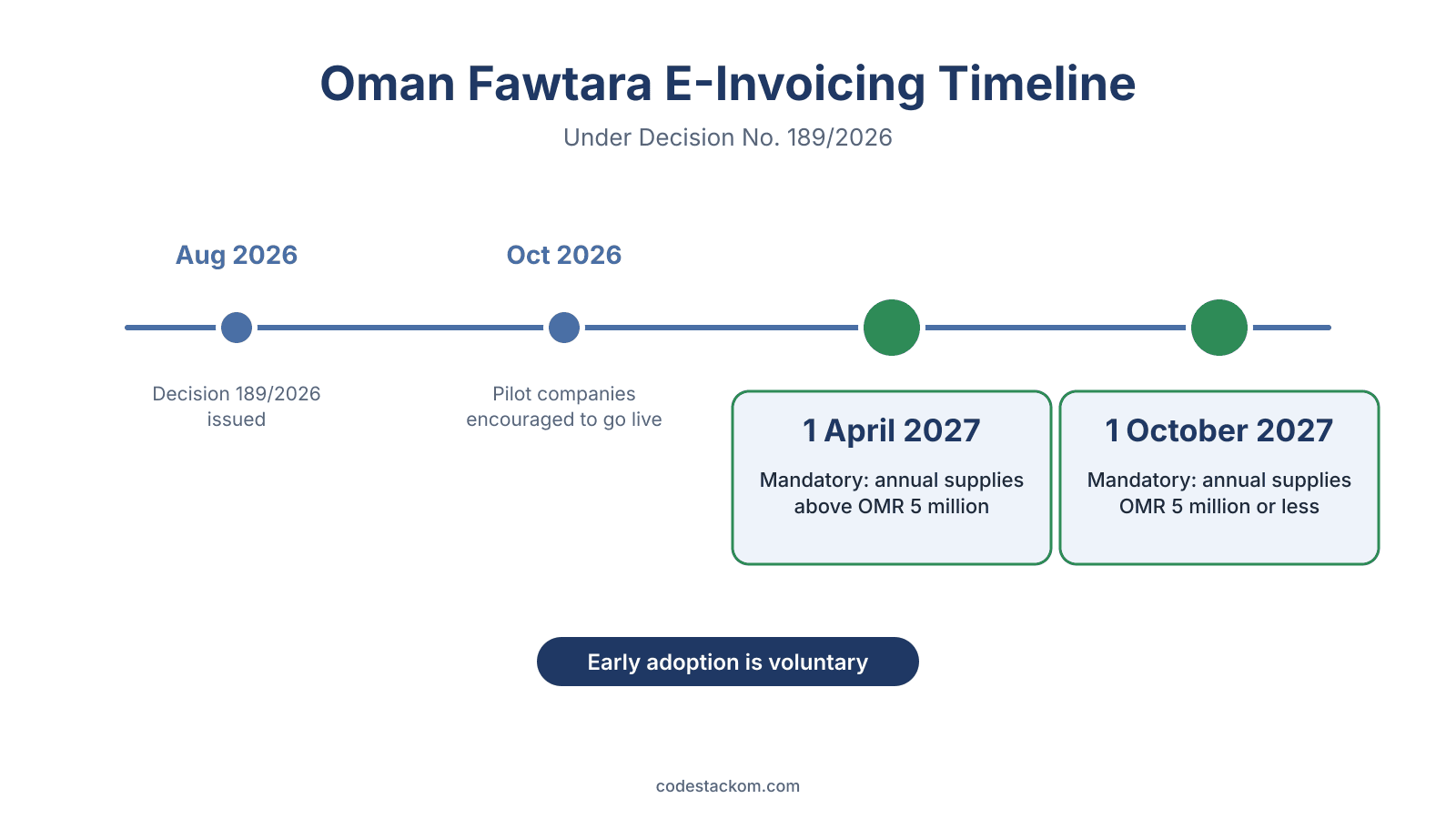
There are now two deadlines instead of four phases. Your date depends on the value of your annual supplies.
New obligations sit with the taxpayer, not just the software. Businesses are now directly responsible for system security, backup plans and data recovery. We cover this below because it is easy to miss.
The New Fawtara Deadlines at a Glance
| Your annual supplies | Mandatory from | Time left (from mid November 2026) |
|---|---|---|
| Above OMR 5 million | 1 April 2027 | About 4.5 months |
| OMR 5 million or less | 1 October 2027 | About 10.5 months |
Two things are worth knowing.
Everyone is covered in the end. The threshold only decides when you join. Every VAT-registered business will have to issue e-invoices.
You can join early. Voluntary early adoption is allowed. No business is legally required to comply before 1 April 2027.
What happened to the pilot companies?
The 100 large taxpayers chosen for the pilot were originally due to go live in August 2026. At a workshop on 11 August 2026, the OTA encouraged them to go live by October 2026. It also said pilot taxpayers would face no e-invoicing penalties until 31 March 2027. If you are one of them, your situation is a little different, so check your OTA correspondence. KPMG's summary of the decision covers the pilot changes in more detail.
What about government entities?
The old roadmap put ministries and government bodies in a later phase, around 2028. The new decision doesn't say whether they now follow the two new dates. If you sell mainly to government, watch for further OTA guidance.
How to Work Out Which Deadline Applies to You
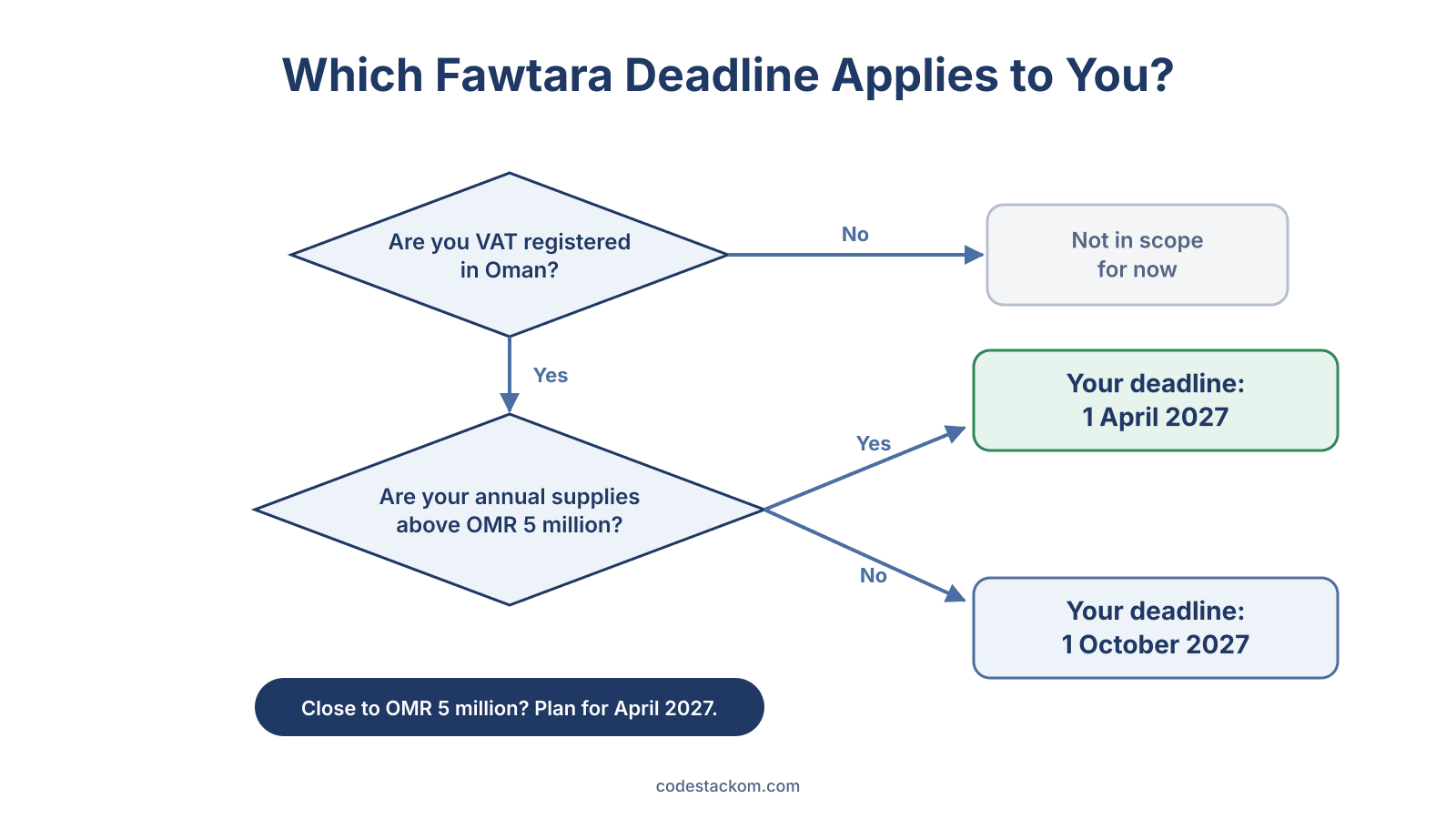
This is where many businesses will get stuck. The decision doesn't explain how to calculate "annual supplies".
The VAT Law has rules for calculating supplies, but those rules were written to decide who must register for VAT. They weren't written for e-invoicing.
So what should you do in practice?
Start with the supplies figure you already use for VAT registration and returns. It is the closest working estimate available.
If you're close to OMR 5 million, plan for 1 April 2027. Being ready early is fine. Missing a deadline you thought didn't apply is not.
If you're part of a group with several VAT registrations, ask your tax advisor how the threshold applies to each entity.
Until the OTA publishes clearer guidance, treat this as a judgement call and get it confirmed by a tax professional.
What Your Invoices Must Look Like Under Fawtara
Once your date arrives, a PDF emailed to a customer no longer counts as a valid tax invoice. Neither does a printed paper invoice or a scanned image.
Under the amended rules, every tax invoice must:
Be issued in an approved, secure electronic format
Carry a unique number
Stay complete, unaltered and stored properly for the required period
Follow the existing timing rules, generally within 15 days of the relevant event
The rules don't stop at standard sales invoices. They also cover:
Simplified tax invoices
Supplies to customers who aren't VAT registered
Deemed supplies and goods taken for private use
Payments received in advance, in full or in part
In earlier workshops, the Oman Tax Authority said e-invoicing would also apply to imports of goods and services, and would be optional for out-of-scope supplies. The new decision doesn't spell this out, so keep an eye on this area too.
How Fawtara Actually Works: The Five-Corner Model
You don't send invoices straight from your accounting system to the Tax Authority. Fawtara uses a five-corner model, which looks like this:
You (the seller) create the invoice in your ERP or accounting system.
Your service provider checks it against the OTA's technical rules and sends it on.
Your buyer's service provider receives it.
Your buyer gets a structured invoice their system can read.
The Tax Authority receives the required tax data.
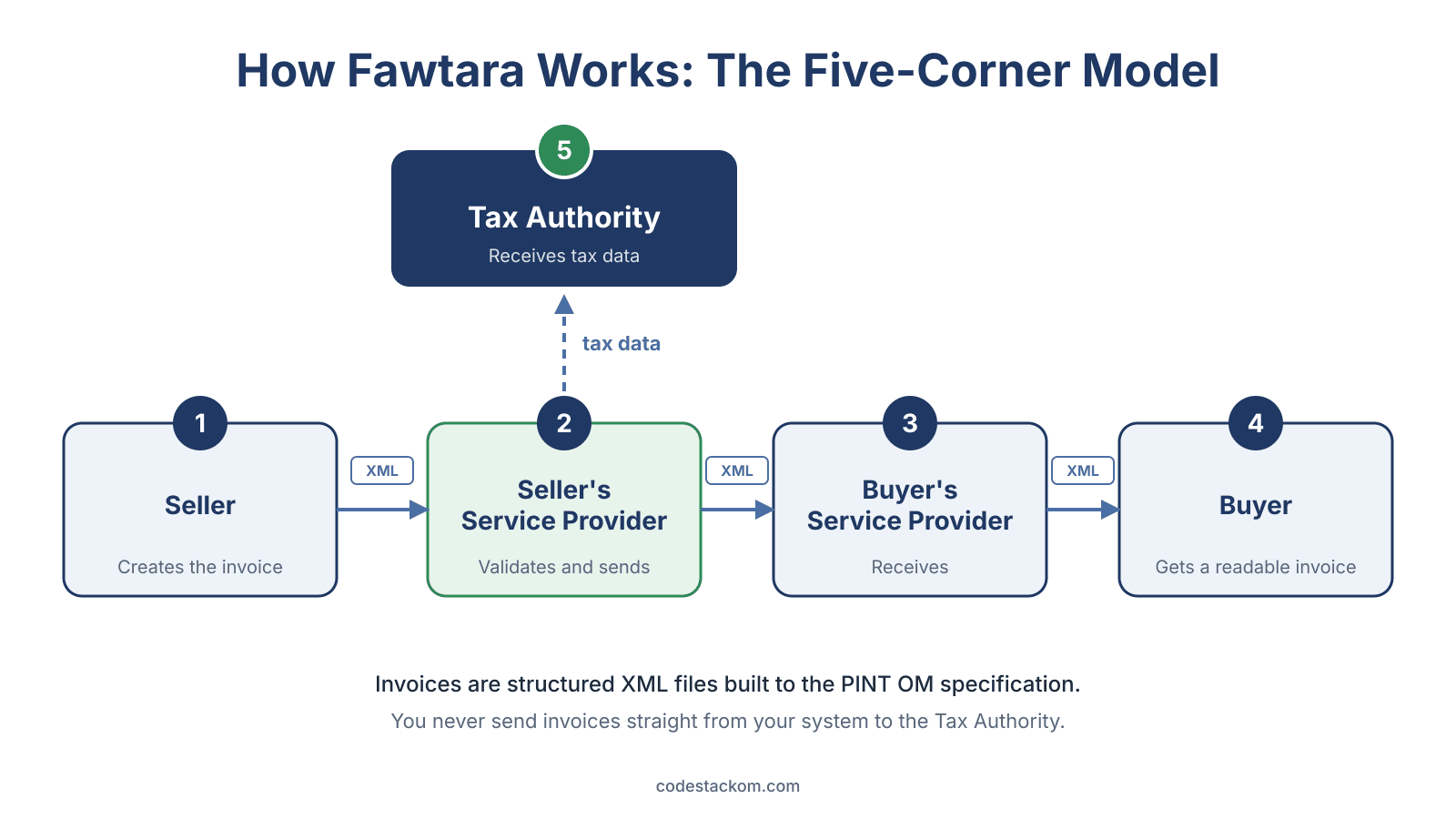
The invoice itself is a structured XML file built to Oman's PINT OM specification. Your system has to produce clean, complete data in that format, or the invoice will be rejected before it reaches your customer.
The decision requires the OTA to publish a list of licensed service providers, and you'll have to use one the Authority recognises. Several providers already hold pre-approved status, and the official Fawtara portal is the place to check who is licensed.
The Part Most Businesses Will Miss: Security and Backup Duties
Decision 189/2026 puts new responsibilities directly on you as the taxpayer. Your invoicing setup must:
Meet the OTA's technical specifications
Be protected against breaches and unauthorised access
Have procedures for emergencies, system breakdowns and technical faults
Have a way to recover lost data so invoicing keeps running
In plain terms, the OTA wants to know what happens if your server goes down on the last day of the month. If your answer today is "we'd wait for IT to fix it", that is a gap you need to close.
Can You Get an Exemption?
The Chairman of the Tax Authority can grant a temporary exemption. You would need to submit a formal request with supporting documents and acceptable reasons. Even with an exemption, you must keep filing VAT returns and paying tax on time.
Don't build your plan around this. It's a safety valve for genuine cases, not an extension for businesses that started late.
What About Penalties?
There is no published penalty schedule specific to e-invoicing yet. The decision doesn't attach its own fines, and the OTA has only said penalties will apply under the regulations.
The lack of a number doesn't mean there's no risk. Invoices that don't count as valid tax invoices create problems for your customers' input VAT claims too. In practice, the pressure to comply may come from your customers before it comes from the OTA.
A Practical Plan to Get Ready
Here's a sensible order of work, whichever deadline applies to you.
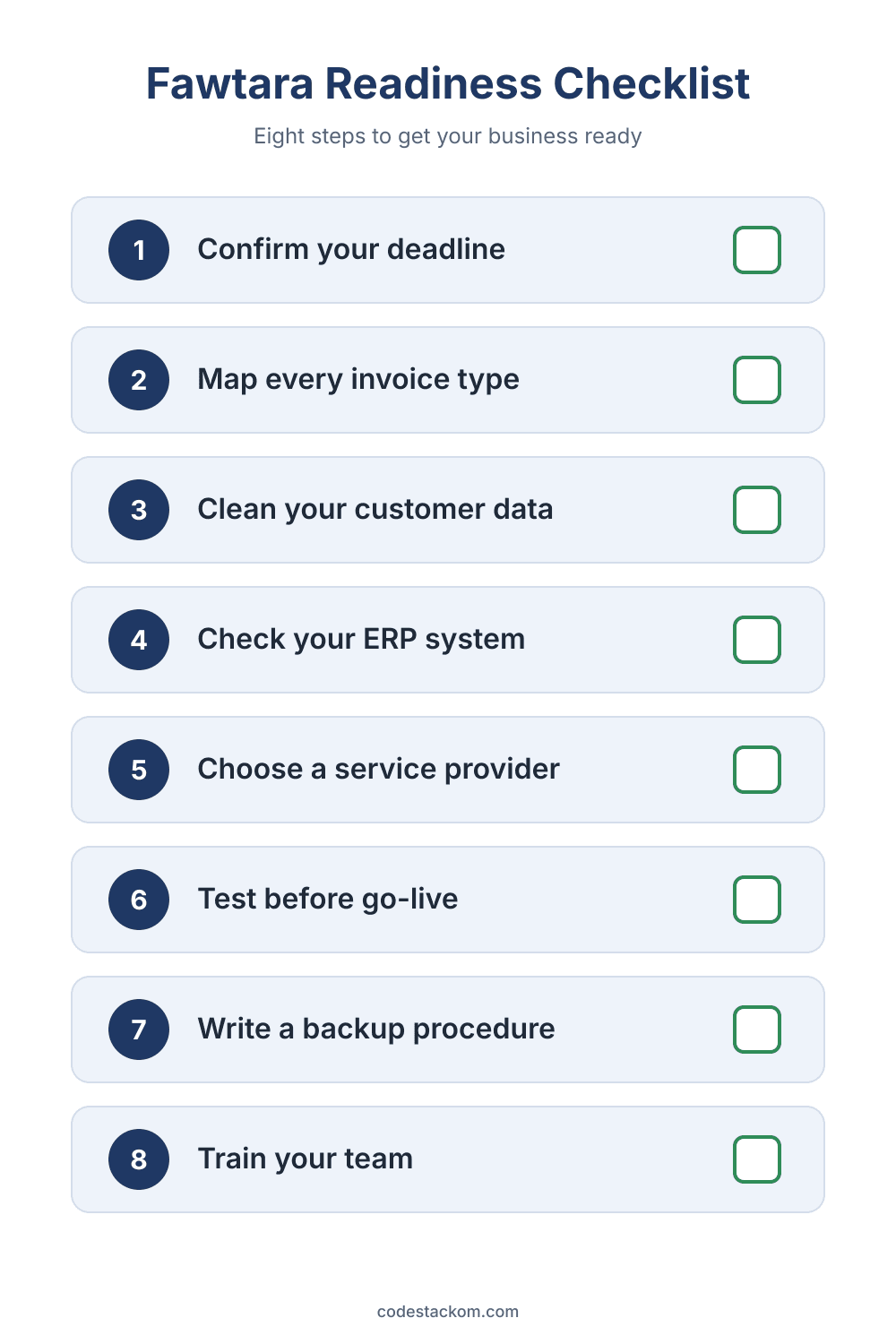
Confirm your deadline. Check your annual supplies figure and agree your date with your finance team or tax advisor.
Map every invoice you issue. List standard invoices, simplified invoices, credit and debit notes, advance payment invoices and any unusual cases. Each one needs to flow through the new process.
Clean your customer data. Wrong VAT numbers, missing addresses and duplicate customer records are the most common reasons e-invoices fail validation. Fixing them now saves a lot of rejected invoices later.
Check your ERP or accounting system. Ask your vendor directly: can it produce PINT OM XML, and how does it connect to a licensed service provider? Older or heavily customised systems may need real work here.
Choose a service provider. Look at their OTA status, how they connect to your system, data residency and the support they'll give you during go-live.
Test before your deadline. Run real invoice scenarios, including credit notes and edge cases, well before go-live.
Write your backup procedure. Document what happens during an outage, who's responsible and how data is recovered. This is now a legal requirement, not just good practice.
Train your team. The people who raise invoices every day need to know what changes, what a rejection looks like and what to do about it.
If you're above OMR 5 million, steps 1 to 5 really should be done before the end of the year.
How Your ERP Fits Into Fawtara
One point that often gets confused: your ERP doesn't make you compliant on its own. Compliance comes from the full chain, meaning your system producing correct data, your service provider validating and exchanging it, and your own controls around security and continuity.
That said, your ERP is where most problems start or get solved. If it can't produce clean, structured invoice data, no service provider can fix that further down the chain. For many Omani businesses, Fawtara is a good moment to look at whether their current setup still fits. If you're weighing your options, our guide to ERP companies in Oman is a useful starting point. Businesses with complex workflows often find that custom ERP software handles Fawtara's data requirements more cleanly than a patched-together system.
Frequently Asked Questions
When does e-invoicing become mandatory in Oman? From 1 April 2027 for businesses with annual supplies above OMR 5 million, and from 1 October 2027 for everyone else who is VAT registered.
Does Fawtara apply to small businesses? Yes. Every VAT-registered business is eventually in scope. Smaller businesses simply join from 1 October 2027.
Is a PDF invoice still valid after my deadline? No. Once your date applies, invoices must be issued in the approved structured electronic format through a licensed service provider.
Can I start e-invoicing before my deadline? Yes. Voluntary early adoption is allowed.
Do I have to use a service provider? Yes. Under the five-corner model, invoices go through a service provider recognised by the Oman Tax Authority.
Is the OTA FAQ still accurate? Not fully. When the decision came out, the OTA's FAQ still showed the older four-phase timetable. Where they differ, rely on Decision 189/2026.
Final Thoughts
The new Fawtara deadlines give most businesses a clearer target, and the smaller ones a little more breathing room. But the work behind e-invoicing (clean data, connected systems, tested processes and a backup plan) takes longer than most teams expect.
If April 2027 applies to you, the time to start is now. If October applies, starting early means you go live calmly instead of in a rush.
If you'd like help checking whether your systems are ready for Fawtara, talk to our team at CodeStack in Muscat.
About CodeStack
CodeStack is a trusted software company in Oman delivering custom ERP systems, advanced GRC platforms, and scalable digital solutions for growing businesses. We help organizations streamline operations, improve compliance, and accelerate digital transformation through secure, business-focused software built for long-term success.

Ready to engineer your next success?
Tell us a bit about your business and we'll get back to you with next steps.