Odoo in Oman: What It Does Well and Where It Falls Short
A straight look at Odoo for Omani businesses, covering VAT and Fawtara compliance, implementation realities, costs, and when a custom ERP makes more sense.
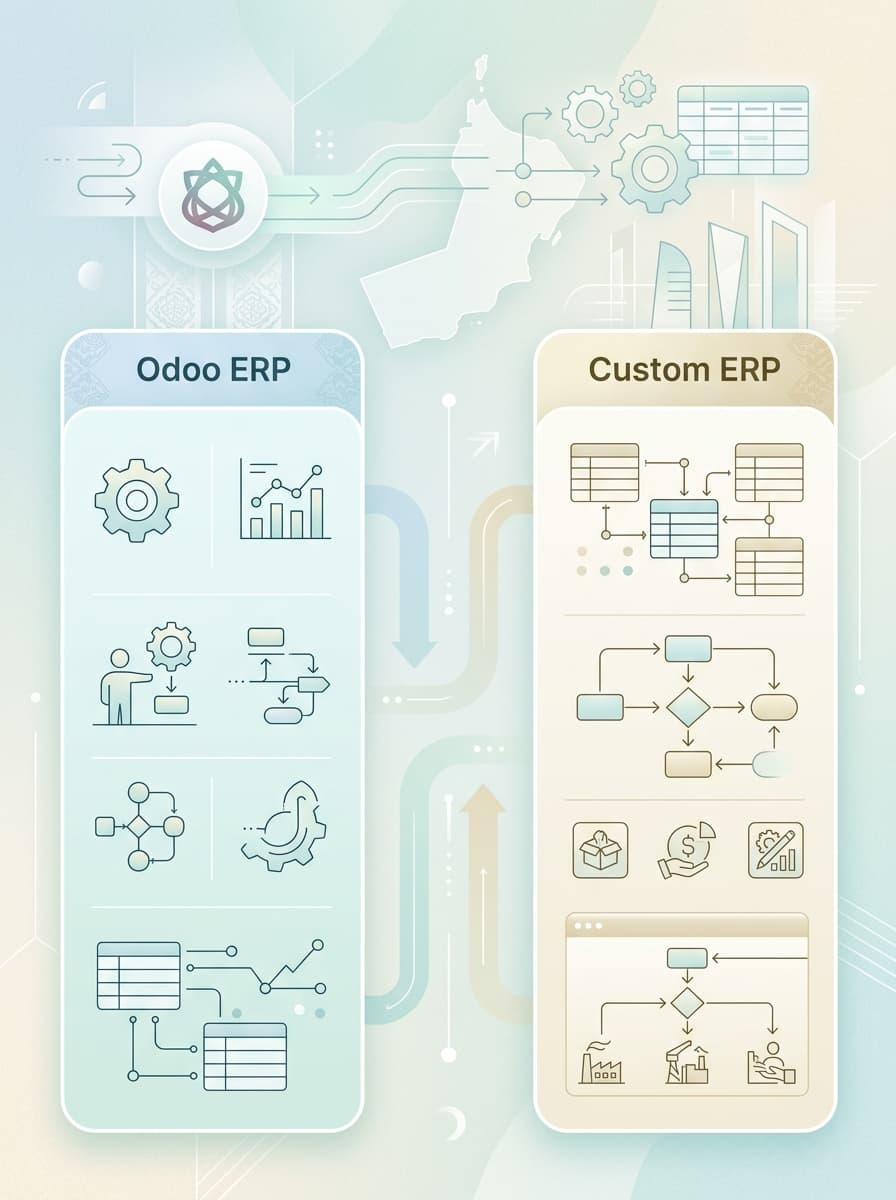
Odoo is probably the most searched ERP platform among Omani businesses right now, and for good reason. It covers a wide range of business functions, has a visible local presence through implementation partners, and its pricing looks attractive compared to enterprise platforms like SAP or Oracle. For certain businesses in Oman, it genuinely is the right call.
For others, it creates problems that only become visible six to twelve months after go-live, usually when a compliance requirement surfaces that the standard modules don't handle cleanly, or when a business process turns out to be just different enough from Odoo's default workflow that the workaround costs more time than the software saves.
This piece is a straight assessment of both sides, based on what Odoo actually does rather than what the marketing says. If you're evaluating ERP options in Oman right now, this should help you make a more honest decision.
What Odoo actually is
Odoo is a modular, open-source ERP platform with a large ecosystem of apps covering accounting, inventory, CRM, HR, manufacturing, project management, and more. You can start with a few modules and add others as your business grows. The community edition is free; the enterprise edition is priced per user per month and includes additional modules, hosting options, and official support.
It has a large global user base, an active developer community, and a reasonable number of implementation partners operating in Oman and the wider GCC. That ecosystem is one of its genuine strengths.
Where Odoo works well for Omani businesses
Standard operations with predictable workflows. Odoo is built around common business processes: purchase orders, sales invoices, stock movements, payroll runs, project tasks. If your business runs along these standard lines without significant exceptions, Odoo's out-of-the-box modules handle them competently and the implementation is usually straightforward.
Small to mid-size businesses getting their first proper ERP. For a business moving off spreadsheets or disconnected tools for the first time, Odoo provides a significant operational upgrade without the cost and complexity of an enterprise platform. The learning curve is manageable and the modular approach means you're not paying for functionality you don't use yet.
Businesses with a limited budget and standard compliance needs. If your VAT situation is relatively straightforward and your payroll doesn't have unusual structure, Odoo's existing localisation for Oman covers the basics at a cost that enterprise alternatives can't match.
Rapid deployment timelines. When a business needs to get operational quickly, a standard Odoo implementation moves faster than a custom build. There's no development phase; configuration and data migration are the main tasks, and experienced partners can turn these around in weeks for simpler setups.
Where Odoo falls short in the Omani context
This is where the honest assessment matters more.
Fawtara e-invoicing compliance is not a solved problem. Oman's e-invoicing requirements under the Fawtara framework are still rolling out, and Odoo's localisation for Oman has historically lagged behind regulatory changes rather than staying ahead of them. How well your specific implementation handles Fawtara depends heavily on which partner built it, what version they're running, and whether they've kept up with updates. This is not a small risk. A compliance gap in your invoicing system is a material business problem, not a software inconvenience.
WPS payroll formatting has gaps in some implementations. The Wage Protection System requires specific file formatting for salary transfers. Odoo's payroll module can be configured to handle this, but it often requires customisation from your implementation partner rather than working out of the box. Ask specifically and get a demonstration before signing anything.
Customisation compounds over time. Odoo is open source, which means it can be customised for almost anything. This sounds like a feature. In practice, heavy customisation creates a maintenance problem: every time Odoo releases a major version update, customised modules need to be reviewed, tested, and often rewritten. Businesses that started with a few small customisations often find themselves, three or four years later, running a heavily modified version that's difficult and expensive to upgrade. The more your implementation deviates from standard Odoo, the more it starts to behave like a bespoke system anyway, without the clean architecture a purpose-built system would have.
Workflow exceptions become expensive quickly. Odoo's strength is standard workflows. Once your business has meaningful exceptions, multi-level approvals that don't match the default, industry-specific processes, or integration requirements with systems that don't have existing Odoo connectors, the implementation cost and timeline start climbing toward what a custom build would have cost from the start. This is the most common situation where businesses end up underserved: they chose Odoo for the price, then spent the difference and more on customisation.
Support quality depends entirely on your partner. Odoo itself provides support for enterprise users, but the quality of day-to-day support in Oman depends on which implementation partner you're working with. Partner quality varies significantly. A good partner makes Odoo work well; a weak one leaves you with a system that was never properly configured and no clear path to fixing it.
The version question: Community vs Enterprise
Odoo Community is free but excludes a number of modules that most businesses actually need, including the full accounting suite, payroll, and several manufacturing features. It also excludes official support and certain hosting options.
Odoo Enterprise adds those modules and support, but it comes with per-user monthly licensing. For a business with thirty users across multiple modules, the annual licensing cost is meaningful and should be factored into any honest cost comparison with alternatives.
When Odoo is probably not the right choice
You should look beyond Odoo if any of the following apply:
Your business has industry-specific compliance requirements beyond standard VAT and payroll
You need deep integration with existing internal systems or proprietary tools
Your approval workflows are more complex than what standard Odoo configuration supports
You're in a sector with high regulatory reporting demands (oil and gas, financial services, government-adjacent)
You've already been through one Odoo implementation that didn't stick
In these situations, the apparent cost advantage of Odoo tends to erode once customisation, integration work, and ongoing maintenance are factored in. A purpose-built system designed around your actual workflows often works out cheaper over a three to five year horizon, even if the upfront cost is higher.
How CodeStack approaches ERP differently
When Odoo's standard modules don't fit a business's actual workflow, the usual response is customisation. But as covered above, heavy customisation on top of an off-the-shelf platform creates its own long-term problems: upgrade friction, maintenance costs, and a system that's simultaneously rigid and fragile.
The alternative is building the ERP around the business from the start rather than configuring a platform to approximate it.
At CodeStack, this is how we approach ERP for businesses in Oman where Odoo or a similar platform isn't the right fit. Instead of starting with a platform's existing data model and working around its constraints, we build the workflows, compliance logic, and integrations your business actually needs. VAT, Fawtara e-invoicing, and WPS payroll aren't added as modules after the fact; they're part of the system design from day one.
The practical difference shows up in a few specific areas:
Compliance is built to your exact requirements. Rather than relying on a localisation module that may or may not be current with Oman's regulatory changes, compliance logic is written to the actual requirements and updated when those requirements change.
Workflow exceptions aren't a problem. If your approval chain has five levels or your inventory process doesn't match any standard template, that's not a customisation challenge; it's just part of the brief.
No upgrade fragility. Because there's no underlying platform version to keep up with, the system doesn't accumulate technical debt every time a vendor releases a major update.
The tradeoff is honest: a custom build takes longer upfront and costs more initially than a standard Odoo deployment. For businesses with straightforward operations, that tradeoff doesn't make sense. For businesses where the complexity is real, it usually does, especially when the total cost over three to five years is what's being compared rather than just the initial quote.
A quick comparison
| Feature | Odoo | Custom ERP (e.g. CodeStack) |
|---|---|---|
| Upfront cost | Lower | Higher |
| Deployment speed | Faster | Slower |
| Oman compliance (VAT, Fawtara, WPS) | Depends on partner and version | Built to spec |
| Customisation flexibility | Limited by architecture | Full |
| Long-term maintenance | Upgrade complexity grows with customisation | Stable if well-built |
| Best for | Standard operations, budget-conscious, straightforward compliance | Complex workflows, specific compliance needs, integration-heavy |
The bottom line
Odoo is a legitimate ERP option for Omani businesses with standard operations, a realistic budget for enterprise licensing, and an experienced local implementation partner. It is not a one-size-fits-all answer, and it is not automatically the cheapest option once the full implementation picture is on the table.
If your operations are straightforward, Odoo is worth serious consideration. If they're not, the honest conversation is whether you're buying a platform that will need to be extensively modified to fit your business, at which point the question of whether a purpose-built system makes more sense is worth asking properly.
If you're at that decision point, our ERP solutions page covers how we approach custom ERP builds for businesses in Oman, including compliance handling and what the implementation process actually looks like.
About CodeStack
CodeStack is a trusted software company in Oman delivering custom ERP systems, advanced GRC platforms, and scalable digital solutions for growing businesses. We help organizations streamline operations, improve compliance, and accelerate digital transformation through secure, business-focused software built for long-term success.
Start the Conversation
Ready to engineer your
next success?
Let's build something extraordinary together. Our team is ready to transform your vision into a scalable reality.